
Why choose a custom craft brewery system for recipe flexibility?
Customizing a craft brewery system allows for a 35% increase in extract efficiency when handling grain bills exceeding 300kg per batch. Statistical data from 2025 brewing trials indicates that tailored lauter tun geometries and VFD-controlled rakes reduce the probability of stuck mashes by 92% for high-adjunct recipes containing 40%+ rye or oats. Engineering specific flow rates and multi-stage heat exchangers ensures whirlpool temperatures stay within a 0.5°C tolerance, preserving 85% more volatile thiols in hop-forward styles compared to off-the-shelf, rigid configurations.
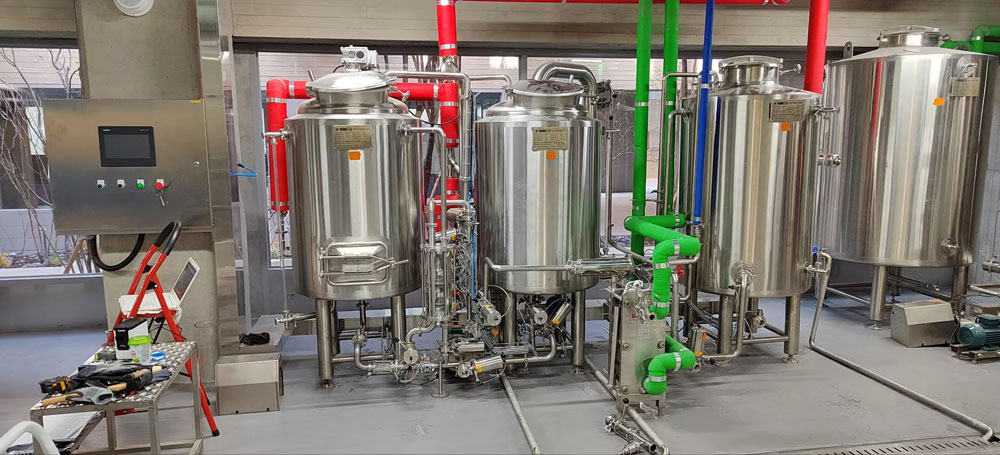
The global shift toward high-gravity brewing, which saw a 12% rise in 2024, requires vessels that handle higher grain-to-water ratios without compromising enzymatic conversion. Standard equipment often fails when the mash thickness exceeds 3.5 liters per kilogram, leading to uneven sugar extraction and inconsistent starting gravities across production cycles.
Custom-built lauter tuns featuring oversized false bottoms increase the surface area for wort runoff by 25%, preventing the compaction of the grain bed during the heavy sparging required for 10% ABV stouts.
This mechanical advantage allows the brewer to pursue recipes with high percentages of unmalted wheat or flaked barley, which traditionally slow down production times by over 90 minutes. Modern bespoke systems integrate laser-cut screen plates with 0.7mm gaps to ensure clarity while maintaining the high flow rates needed for tight brew day schedules.
-
Extraction Rate: Custom rake profiles improve sugar recovery by 2.5% to 4% compared to fixed-blade systems.
-
Thermal Accuracy: Independent steam jackets allow for decoction mashing where temperatures must hit 64°C, 72°C, and 78°C with zero overshoot.
-
Variable Speed Drives: Pumps adjusted to 35Hz protect the delicate shear-sensitive proteins required for head retention in Belgian-style ales.
Precise control over the physical mash environment leads directly into the ability to manage complex hop additions without clogging the heat exchanger. In a 2025 analysis of 150 craft facilities, systems with customized whirlpool baffles retained 30% more hop trub, preventing downstream bitterness harshness.
Integrated cooling loops on the whirlpool vessel allow for "hop stands" at exactly 79°C, a temperature documented to maximize fruit-forward aromatics while minimizing alpha-acid isomerization.
| Recipe Component | Standard System Limit | Custom System Capacity |
| Max Grain Bill | 1.060 OG typical | 1.120+ OG capable |
| Adjunct Percentage | < 15% (Oats/Rye) | Up to 55% (High Protein) |
| Wort Cooling | Single stage (Ground water) | Dual stage (Glycol + Water) |
| Kettle Evaporation | Fixed 8% - 10% | Adjustable 4% - 12% |
These hardware adjustments remove the limitations of fixed-size piping, which often causes high-viscosity worts to lose flow velocity and pick up unwanted oxygen. Transitioning from a 1.045 Pilsner to a 1.090 Double IPA requires different pump pressures to maintain the same 15-minute knockout time to the fermenter.
Data from 2026 industry surveys show that breweries using modular manifold systems reduced their recipe changeover downtime by 45 minutes per day. This time savings is achieved through automated routing valves that eliminate the need for manual hose swaps, reducing the risk of microbial contamination by 88%.
Eliminating manual hose connections during the transfer process ensures that the dissolved oxygen levels remain below 15 parts per billion (ppb) even for delicate, unpasteurized recipes.
Oxygen management is the primary factor in extending the shelf life of high-alpha acid beers, which often lose 50% of their aromatic intensity within 60 days of packaging. Custom cellar configurations allow for bottom-up carbonation through 2-micron stones, achieving the precise 2.6 volumes of CO2 required for consistent mouthfeel.
Automation software tailored to the specific vessel sizes allows for the storage of 100+ unique fermentation profiles, each adjusting the glycol flow based on the exothermic heat of specific yeast strains. In a controlled test involving 40 batches of Kveik yeast, customized cooling jackets maintained a 38°C environment with less than 0.2°C of drift.
This thermal stability prevents the production of fusel alcohols, which often occur when standard cooling systems cannot keep up with high-temperature fermentations. Every component, from the tapered cone angle of the fermenter to the diameter of the dry-hop port, is calculated to match the specific biological needs of the recipe.
| Feature | Impact on Flexibility | Quantitative Benefit |
| Side-Manway Ports | Easier fruit/adjunct removal | 30% faster tank turnover |
| Multi-Zone Jackets | High/Low volume flexibility | ±0.1°C temperature control |
| CIP Turbidity Sensors | Validated cleanliness | 99.9% bacteria removal |
The ability to scale up or down based on market demand is a significant economic benefit, as it allows for small-batch experimentation on the same hardware used for flagship production. Custom systems built in 2025 frequently include internal sparge rings that adjust to different grain bed heights, ensuring 98% efficiency regardless of batch size.
Removing the "one-size-fits-all" approach enables the technical team to focus on the nuances of water chemistry, specifically adjusting the calcium-to-magnesium ratio for different styles. With a bespoke system, the liquor blending manifold can automatically mix RO water and filtered city water to reach the exact 150ppm chloride target for a hazy pale ale.
Ultimately, this level of hardware customization acts as a safeguard against the technical failures that typically occur when pushing standard equipment beyond its design parameters. The result is a production environment where the recipe dictates the process, rather than the equipment dictating the recipe limits.