
Production Lead Times for a Vegan-Positioned Fragrance Line
A vegan positioning rarely makes a fragrance harder to manufacture, but it almost always makes the calendar longer, because the claim has to be evidenced rather than asserted. Material statements, supplier declarations and label wording all have to be collected before the product ships. Brands that plan for that early lose a few days; brands that discover it at artwork stage lose a launch window.
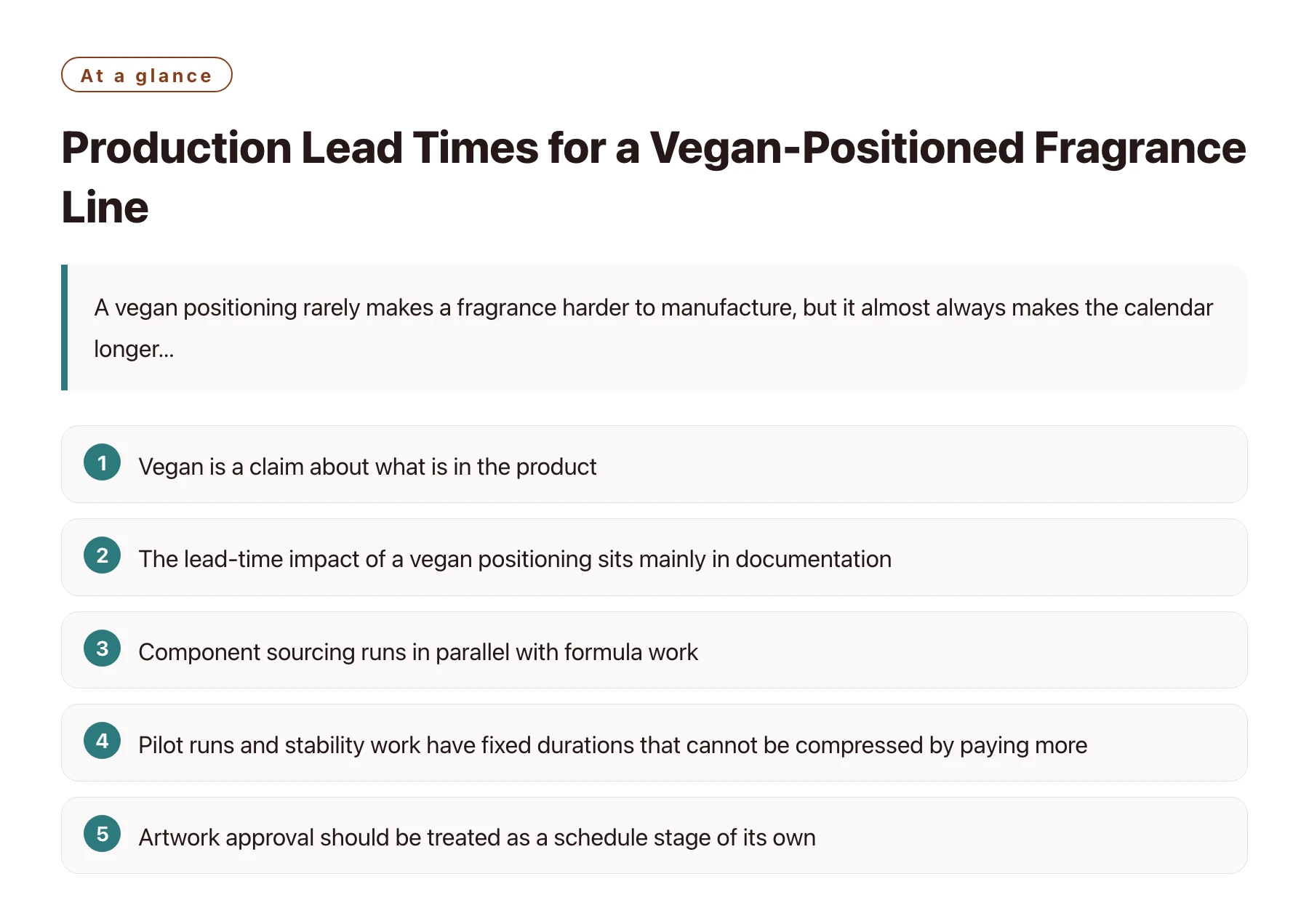
Key takeawaysVegan is a claim about what is in the product, and claims about cosmetics are expected to be substantiated in the markets where the product is sold. · The lead-time impact of a vegan positioning sits mainly in documentation, material confirmation and label review rather than in production itself. · Component sourcing runs in parallel with formula work, so bottle, closure and refill lead times often decide the critical path rather than the concentrate. · Pilot runs and stability work have fixed durations that cannot be compressed by paying more, so they should be scheduled first and everything else fitted around them. · Artwork approval should be treated as a schedule stage of its own, because it routinely sits on the critical path and is the most common cause of a slipped launch.
Lead times are usually quoted as a single figure, which hides the fact that they are a chain of dependent stages. Some stages run in parallel and can absorb delay; others are fixed and cannot. Understanding which is which is what allows a brand to plan a launch date that survives contact with reality.
A vegan positioning is a useful case study because it changes the documentation load while leaving the manufacturing process largely untouched. It shows clearly where schedule risk accumulates and which confirmations are worth requesting in writing at the start.
Where the calendar is actually spent
| Stage | What sets the clock | What to confirm in writing |
|---|---|---|
| Brief to feasibility | How specific the brief is and how many questions the supplier has to resolve | Which parts of the brief cannot be met, and the assumptions used for the rest |
| Accord selection or development | Library accords take days; developed accords take revision rounds | Number of directions, revision rounds included, and the approval gate |
| Material and documentation review | Declarations that have to be collected from material suppliers | Which declarations the supplier provides and which fall to the brand |
| Component sourcing | Bottle, pump, closure and refill lead times, plus decoration setup | Whether components are in stock, and the lead time for the decoration method chosen |
| Pilot run | Line scheduling and the availability of components | What the pilot proves, and what happens if it fails |
| Stability and compatibility testing | Protocol duration, which is measured in weeks rather than days | The protocol, the conditions and the acceptance criteria |
| Artwork and label review | Copy approval, market-specific wording and print queue | Who checks the ingredient and claim wording before print |
| Bulk production and freight | Order size, packing method and route | Packing standard, documentation for export and customs handling |
Mark the two rows with the longest fixed duration. Those are the rows the launch date should be built around.
What a vegan positioning changes
The claim has to be evidenced, not just stated
Vegan usually describes the absence of animal-derived materials from the product, and it is distinct from a claim about animal testing. Both are claims about a cosmetic product, and claims of this kind are expected to be substantiated and not misleading where the product is sold [1]. In practice that means the brand needs material-level confirmation, not a general statement of intent.
The efficient way to obtain it is to ask at brief stage which materials in the proposed formula could raise a question, and to request the supporting declaration for each. Suppliers that work with international material standards already hold much of this information, because the same standards govern what may be used and in which product categories [2]. The conversation is easier before the accord is fixed than after.
Cruelty-free and vegan answer different questions
Brands frequently bundle the two claims, and the documentation behind them is not the same. Animal testing of cosmetic products has been prohibited in the European Union for finished products and, later, for ingredients, which is why a cruelty-free statement in that market rests on a regulatory position as much as on a supplier promise [1]. Vegan, by contrast, is about material content and has to be checked formula by formula.
Getting this wrong is a labelling problem rather than a production problem. It is worth deciding early which claims the brand intends to make, so that the artwork review covers them once instead of three times.
Other markets add their own steps to the calendar
A product sold in more than one country accumulates documentation. Cosmetic notification regimes differ between markets, and each one adds a step that has to happen before sale rather than before production [3]. When the first market and the second market have different requirements, it is usually cheaper to design artwork that can carry both from the start.
This is the point at which lead times stop being a manufacturing question. The factory may be ready weeks before the documentation and artwork are, and the launch waits on the slower of the two.
How to ask for a schedule you can hold a supplier to
Ask for the schedule as a list of stages with durations, not as a total. A total tells the brand nothing about where to apply pressure; a stage list shows which items run in parallel and which cannot move. It also gives both sides a shared reference when a stage slips.
Because component lead times frequently set the critical path, it is worth knowing how far the supplier's own scope extends. When a factory sources the bottle, the closure and the carton as well as filling it, fewer handovers have to be coordinated, and the schedule reflects one planning process instead of several. Suppliers present their OEM/ODM manufacturing services in scope terms rather than calendar terms, so the stage list has to be requested explicitly.
It is also reasonable to ask how a schedule is affected by geography. It is also reasonable to ask how a schedule is affected by geography: contract perfume manufacturing in China typically adds ocean freight and customs clearance to the calendar after production, and air freight changes the cost rather than the sequence. Planning backwards from the shelf date with those legs included is more reliable than adding them at the end.
Finally, treat the supplier's own published stages as a checklist to compare against. The stage list a Xuelei perfume manufacturer describes is a reasonable starting point, and the useful exercise is to find the stages your quote does not mention.
Build the launch date from the two longest fixed stages, not from the total quoted. Stability testing and artwork approval are the two that most often move a first launch.
Sources
- European Commission: Cosmetics in the EU —— The European Commission's overview of EU cosmetics rules, including the responsible person, product information file and safety report requirements.
- Cosmetics Europe —— The European trade association for the cosmetics and personal care industry, publishing guidance, positions and market information.
- Health Canada: Cosmetic Safety —— Health Canada's cosmetics pages, covering cosmetic notification, the ingredient hotlist and safety requirements for cosmetics sold in Canada.
Frequently asked questions
Does a vegan fragrance take longer to manufacture?
Manufacturing is largely unaffected. The additional time sits in collecting material declarations, confirming the formula and reviewing label wording before the product can be sold.
How long does a first fragrance production run usually take?
It depends on whether the accord is developed or selected, and on component availability. Rather than rely on an average, ask for a stage-by-stage schedule and note which stages cannot be compressed.
Can I speed up a launch by paying for faster production?
Sometimes for filling and freight, rarely for testing. Stability and compatibility work has a fixed duration, and shortening it weakens the evidence behind the product.
Is vegan the same as cruelty-free?
No. Vegan concerns the materials in the product; cruelty-free concerns animal testing. They require different evidence and are regulated differently depending on the market.
What is the most common cause of a slipped fragrance launch?
Artwork and label approval, usually because market-specific wording and claims were not settled before print. Treating it as a scheduled stage rather than a formality prevents most of the delay.