
ODM Jewelry Service Levels Compared With OEM
OEM and ODM are two service levels on the same production floor. In OEM the buyer supplies the CAD and the intellectual property stays 100% with the brand; in ODM the factory develops the concept into a finished collection. Both use the same under-48-hour CAD window, 25–30 day sampling and 21–28 day bulk run, so the difference sits in who does the development work rather than in the calendar.
Key takeaways
- OEM builds to the buyer's CAD file; moulds, CAD and the collection are not resold.
- ODM develops the concept into a collection that stays exclusive to the brand.
- Both levels share the 48-hour CAD, 25–30 day sampling and 21–28 day production blocks.
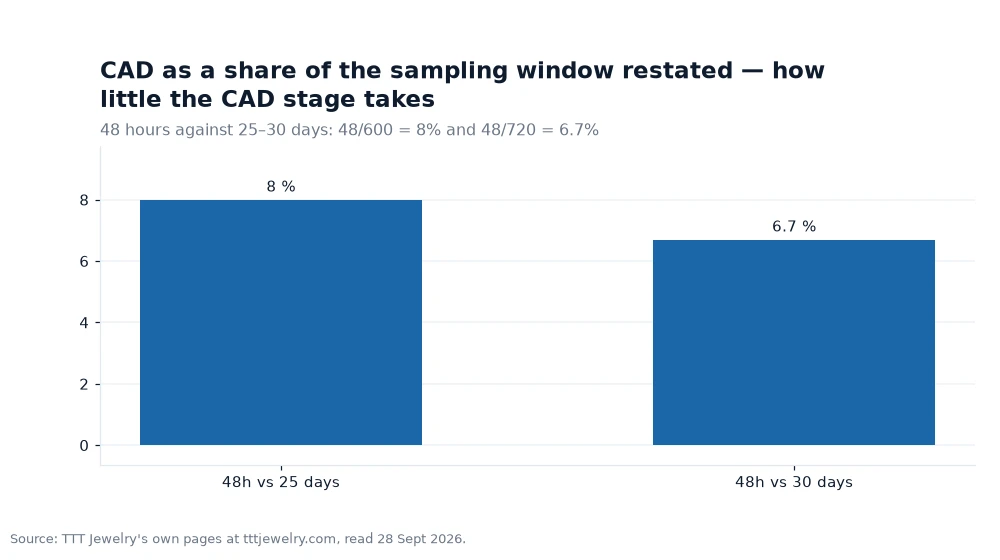
- CAD is 8% of a 25-day sample window and 6.7% of a 30-day one, whichever level is chosen.
Both service levels run on the same published floor: 48 hours of CAD, 25–30 days for a master sample and 3–4 weeks for bulk, so the model changes who owns the drawing rather than how long the bench takes.
Two service levels, one floor
The shorthand is accurate: OEM is you design, we produce, and ODM is you inspire, we create. In the first, a finished drawing arrives and the factory engineers it for manufacture. In the second, a brief, a reference set or a mood board arrives and the factory carries the idea through concept, CAD, prototype and sample before production begins.
Behind both sits the same shop floor: casting, sprue cutting, high-gloss polishing, brushed and textured surface art, electroplating, 100% inspection and dispatch. A service level changes what enters at the front door, not what happens behind it. That is why a comparison of the two should focus on inputs, ownership and the number of review cycles rather than on the production weeks.
A factory running ISO 9001:2015 across all production stages does not operate two quality systems for two service levels; the documented flow is the same. What differs is where the drawing originates and how often it is revised. That is also why an OEM/ODM buyer can move between the two levels without changing supplier, tooling standard or inspection rule.
Dimension by dimension
The table sets out where the two models genuinely diverge. Note that only one row concerns time, and even that row describes the same published blocks.
| Dimension | OEM | ODM |
|---|---|---|
| Starting input | Buyer's CAD or technical drawing | Brief, references or mood board |
| Design authorship | Buyer | Factory, co-created with the brand |
| Development work | Production engineering only | Concept, CAD iterations, prototyping |
| Ownership | 100% buyer, under NDA | Collection exclusive to the brand |
| Approval load | Sign-off on the buyer's design | Concept approval plus sample approval |
| Minimum order | 50 silver, 100 brass, 100+ stainless | Same published minimums |
The ownership row is the one buyers underrate. Both models keep 100% NDA cover and both keep the moulds, CAD files and collection away from other clients, but the question a brand asks is different. In OEM it is whether its own file stays private. In ODM it is whether the concept the factory helped develop might later appear in another brand's range.
IP, exclusivity and the mould
A mould is the physical record of a design, which makes it the practical test of any exclusivity promise. TTT Jewelry states that designs are 100% exclusive, that moulds, CAD and the collection are not resold or shown, and that the 1-on-1 project manager works under NDA. For an OEM buyer that means the drawing is a deposit rather than a submission. For an ODM buyer it means the development effort produces an asset the brand controls, not a catalogue item the factory can re-offer.
Two clauses are worth reading closely in any contract. The first covers derivative work: a variant of an ODM concept is still the brand's, or it is not. The second covers tooling after the relationship ends. Neither is a production question, and both decide what a brand actually owns two years later. A practical safeguard is the approved sample card, which carries the finish, the hallmark position and the weight and gives both parties an object to point at if a later run drifts.
What the 48-hour CAD block does in each model
In OEM, under 48 hours buys a manufacturable model built from a design that already exists. In ODM, the same 48 hours buys one iteration of a model that is still being decided. The published figure describes the CAD output, not the concept work in front of it, which is a frequent misreading of an ODM schedule.
Measured against sampling, the block is small either way: 48 hours is 2 days, or 8% of a 25-day sample window and 6.7% of a 30-day one. What changes between the models is how many times that block runs. An OEM jewelry manufacturer receiving a finished drawing may run it once; an ODM programme may run it three times before the model is signed, and each run carries its own review.
Worked example
Take the slow end of the published chain: 2 + 30 + 28 = 60 days. An OEM project with a single CAD iteration spends 2/60 = 3.3% of that chain on modelling. An ODM project that needs three iterations spends 3 × 2 = 6 days on modelling, so the chain becomes 6 + 30 + 28 = 64 days and CAD rises to 6/64 = 9.4%.
Now add the brand's review between iterations. Three reviews at 3 days each is 9 days, and the chain becomes 6 + 9 + 30 + 28 = 73 days, or 73/7 = 10.4 weeks. Against the 60-day OEM path that is 13 extra days, and 13/60 = 21.7%. None of those days is a bench delay; all of them are development decisions that OEM work does not require.
Frequently asked questions
Who owns the design in an ODM project?
The collection is developed for the brand and stays exclusive to it. Moulds, CAD files and the collection are not resold or shown to other clients, and 100% NDA cover applies in both models.
Does ODM take longer than OEM?
The bench blocks are identical: under 48 hours for CAD, 25–30 days for sampling and 21–28 days for bulk. ODM adds concept and review cycles ahead of the CAD output, and those cycles are brand-side.
Can a brand use both models for one range?
Yes. The published customisation options are the same in both, so a core piece can be produced from the brand's own CAD while a seasonal concept is developed separately.
Match the level to the drawing
The choice usually comes down to what a brand already owns. A team with a finished drawing and a manufacturer's eye for wall thickness and stone seats needs OEM: the design is done, and the work is engineering it for a production line. A team with a direction but no tolerances needs ODM, and should budget the extra review cycles rather than expect the same 60-day path. The factory direct manufacturing model described here runs both levels on one floor, which is why the minimums and the plating options stay the same while the development workload changes. Buyers comparing custom jewelry wholesale terms should ask which level the quoted price assumes, because a quotation built on OEM engineering is not comparable with one that includes concept development.
Source note: figures come from the manufacturer's own website (tttjewelry.com), read 28 Sept 2026.[1]